
INDICATORS / ONE MILLION / MATRIX
Matrix — Read the Whole Picture
See which parts of One Million agree. Read Money, Cloud, Mountain, Rada, Swim, Pool, Mark, and Pilot across the Matrix, then compare Power and the Matrix count below.
1. Find the three reading areas
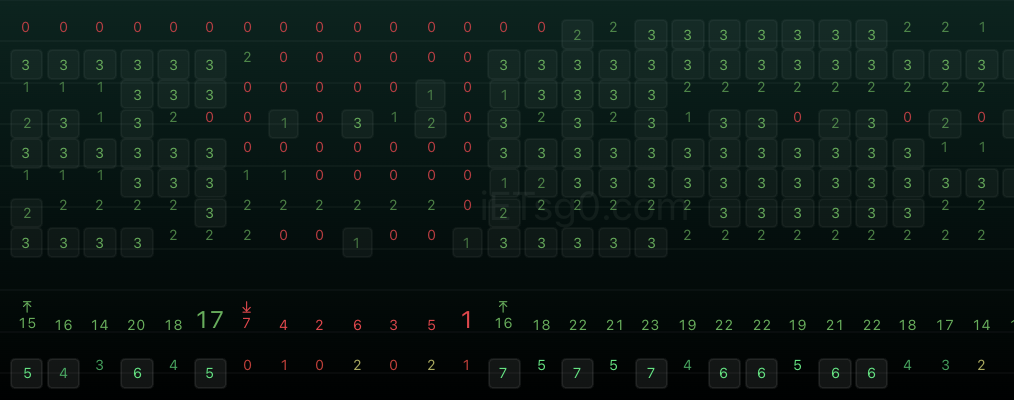
Matrix makes the different parts of One Million visible side by side. The large grid shows individual readings. Power sits beneath that grid, and the Matrix count is the lowest number row. Keep these three areas separate as you read.
A column brings together readings from the same candle. A row follows one named part across successive candles. Read down to compare agreement at one moment; read across to see whether that agreement lasts.
| Area | What you see | Question to ask |
|---|---|---|
| Matrix grid | Eight rows of 0, 1, 2, and 3, with some cells highlighted. | Which parts are strong, weak, or changing? |
| Power | The number row immediately below the grid, sometimes with arrows. | Does the overall Power reading strengthen or fade? |
| Matrix count | The bottom number row, with selected counts boxed. | Is improvement spread across the view or limited to fewer parts? |
2. Learn the eight Matrix rows
In the supplied One Million layout, the rows run from Money at the top to Pilot at the bottom. The names are outside this image crop, so use this order to identify them.
The Pool row is the overall Pool reading in this Matrix. It is separate from the individual Pool 1, Pool 2, Pool 3, Pool 4, and Pool 5 items explained in the Swim & Pool guide.
| Row, top to bottom | One Million name | What to compare |
|---|---|---|
| 1 | Money | Does Money join the stronger block, or stay behind? |
| 2 | Cloud | Does Cloud hold its reading while the other rows change? |
| 3 | Mountain | Does Mountain improve with Money and Cloud? |
| 4 | Rada | Are Rada changes isolated or shared by nearby rows? |
| 5 | Swim | Does Swim maintain its stronger readings across several candles? |
| 6 | Pool | Does the overall Pool reading agree with Swim and Pilot? |
| 7 | Mark | Does Mark strengthen with the rest of the Matrix? |
| 8 | Pilot | Does Pilot join the improvement or begin to fade? |
3. Read the numbers before the colors
Each grid cell displays a reading from 0 to 3. A 0 is the lowest state in that row and a 3 is the highest. Read 1 and 2 as intermediate states, then compare the named row with its own preceding readings.
The rows can reach their states at different moments. A 2 in Money and a 2 in Pilot do not make the two rows interchangeable. Their names tell you which part of One Million you are reading.
- A run of 3s shows that a row is holding its highest displayed state across those candles.
- A row returning toward 1 or 0 shows a weaker displayed state than its earlier 3s.
- A red 0 stands out clearly, but some lower readings can also use green shades. Read the numeral rather than treating every green cell as equally strong.
- These cell numbers are not percentages, price targets, trade counts, or promises about the next candle.
4. Understand the highlighted cells
Highlighted cells draw your attention to improvement or strength being maintained in that row. A long band of highlighted 3s is different from one highlighted cell surrounded by weaker readings.
A highlighted 1 or 2 is not the same as a 3. It can be a useful change to watch while that row is still below its highest state. Compare what follows it before treating the change as lasting.
Read across the row first, then check the neighboring rows in the same column. Several rows improving together describe a broader change than one isolated highlighted cell.
5. Compare Power with the Matrix count
Power gives the overall Power reading, while the Matrix count helps you judge how broadly improvement is showing. They are separate readings, and they do not always rise or fall together.
A strong Power reading with a lower Matrix count can mean the view still holds strength while fewer parts are improving. A rising Matrix count while Power is still low can mark an early change that needs more time. Compare both with the grid before drawing a conclusion.
Boxes in the bottom row draw attention to selected Matrix changes. Their meaning is separate from the highlighted cells in the main grid. A boxed count alone does not mean every row is strong.
| Visible combination | How to read it | What to check next |
|---|---|---|
| Stronger Power, stronger Matrix count | Strength and broader improvement appear together. | Whether the grid keeps its stronger readings on later candles. |
| Stronger Power, lower Matrix count | Strength remains, but improvement is less widespread. | Which rows are holding and which are slipping. |
| Lower Power, rising Matrix count | Some parts are beginning to improve from a weaker picture. | Whether more rows follow and Power strengthens afterward. |
| Lower Power, lower Matrix count | The view is weak without broad improvement yet. | Which named rows change first and whether others join them. |
6. Keep Power arrows and number sizes separate
⤒ marks a sharp upward Power change; ⤓ marks a sharp downward Power change. The number beside the arrow in this view is the Power reading at that moment. It is separate from the Matrix count underneath.
Larger Power numerals add emphasis but remain Power readings. In this image, the large 17 and 1 should be compared with their neighboring Power values, not read as a different score.
An arrow records a change that occurred. The following Matrix columns show whether that change spreads, holds, or fades.
7. Walk through this Matrix image
The image illustrates weakening, a shared improvement, and then less widespread improvement near the right edge. It does not include price candles, the market name, or the chart interval, so it cannot establish what price did next.
- Left — strength is uneven: several rows hold repeated 3s while Money at the top remains at 0. Power readings around 15–20 show strength in parts of the view, but the rows are not all in their highest state.
- Toward the middle — the picture weakens: more red 0s appear and the strong blocks break apart. Power falls from the emphasized 17 to 7, followed by a series of lower readings. The bottom Matrix counts are also mostly low.
- Near the central change — compare the same column: Power rises sharply from 1 to 16 beside an upward arrow, and the Matrix count reaches 7. Several rows become stronger together. Money is still at 0 initially, so this is broad improvement without every row being strong.
- Right of center — strength spreads and holds: many rows show repeated highlighted 3s, Money also improves, and Power reaches readings including 22 and 23. Several Matrix counts of 6 and 7 accompany this stronger block.
- Farther right — compare persistence with fresh improvement: Power remains relatively strong for a time, while the Matrix counts ease toward 4, 3, and 2. Some grid readings soften. The earlier strong block is useful context, but the newest columns deserve a fresh reading.
8. Follow three possible next developments
| Possible development | What to watch | Reading |
|---|---|---|
| The strong block continues | Several rows keep their 3s and Power stays strong while Matrix remains supportive. | The stronger picture continues across more candles. |
| The block begins to break apart | More rows return toward 1 or 0, Power falls, and the Matrix count stays low. | The earlier shared strength is fading. |
| A new improvement begins | Lower rows start to lift, highlighted cells spread, and the Matrix count improves before Power fully recovers. | Watch whether the early changes develop into a broader strong block. |
9. Use a repeatable Matrix reading routine
Matrix is most useful when you read the names, numbers, and changes together. One cell, one box, or one arrow gives only part of the picture.
- Choose a completed candle and read its column from Money down to Pilot.
- Identify which rows are at 3, which are weaker, and which changed from the preceding column.
- Compare the Power reading and Matrix count directly underneath that same moment.
- Look across the next completed columns to see whether the stronger readings persist or break apart.
- Compare the Matrix picture with Trust and P/H/S/R in One Million, or Swim and Pool 1–5 in the companion view, using the same market and interval.
- Keep current readings separate from earlier strong blocks. The latest column can change while its candle is developing.
Need help? Contact support.